
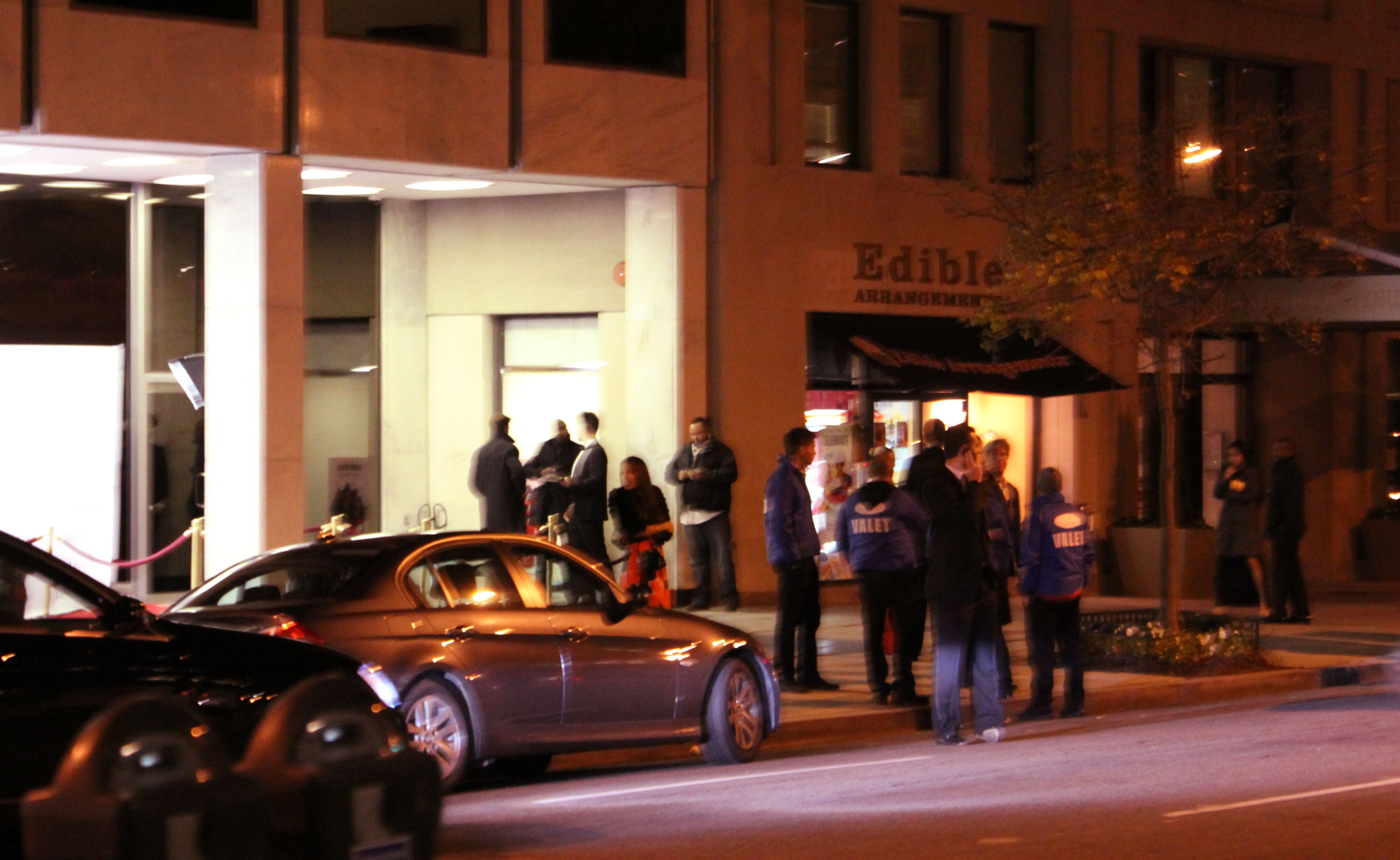
The official opening of the Huxley, a new night club at Dupont Circle, on Nov.15. Photo: Annette Birch
by Annette Birch
The Huxley, a new night club Las Vegas style at Dupont Circle, opened Thursday night Nov. 15. Even a block away, it’s obvious that the Huxley is a different kind of club. The new Dupont Circle night club aims for a Las Vegas-style of exclusivity and the front door had a quiet ambiance to it which contrasted with the usual line of chatting clubgoers down the street.
The private opening was attended by 280 guests, including Vincent Gray, mayor of Washington, D.C., who did the ribbon cutting, and other people in entertainment, politics and media. Eric Lund, one of the owners of the Huxley, said the club aims for a high level of customer service.
“For example a presentation of a bottle of expensive champagne becomes an event, not just a presentation,” he said.
New combination of high style night club and event place at Dupont Circle
The night club opened for the public on Friday and will in future only be a night club on Fridays and Saturdays, while on Sundays to Thursday it hosts private events such as charity balls and private parties.
The idea of starting a combined night club and event place himself is not new to Lund, who has been producing night life events for years.
“I always wanted to have my own space and have been looking for the right location and space for it in several years. Dupont Circle is one of the best locations in the city and this place has high ceilings and venues on the ground floor which otherwise is difficult to find here,” he said.
Earlier, the night club stated that admission on opening night would be restricted to a guest list, an unusual event in Washington, D.C.’ nightlife. After a number of people complained in Internet forums, the owners announced anyone could come by reserving a table in advance or if they arrived in black-tie formal wear.
The opening is in the center of a boiling night life
Huxley Night Club opens in Dupont Circle, an area that with its many restaurants, cafes, bars and lounges, is already known for its night life and upper scale clientele. Ravi Bayankar, who works at entertainment company Panorama Productions, said Washington’s nightlife is very diverse and upscale.
“You’ll find celebrity actors, musicians, athletes and politicians mixed in with college students, artists, lobbyists, business owners, finance people, etc.,” he said.
Bayankar said the area north of Dupont Circle is known for restaurants that are quaint and gay-friendly, while the area to the south, where the Huxley is, features more dance clubs and pop music.
Usman Jack Asif from Night Life Agency, an agency which arranges events at night clubs, agrees.
“The clientele is mostly upper scale. For example at Current, you can purchase VIP tables for $ 300 a table or just pay at the door.” The clubs has a capacity for up to 600 people, some up to 3,000. The night club Current allows both guests to reserve spaces in advance on a guest list and pay at the door.
On contrast, The Huxley is much smaller, requires stricter dress code and aims for a more exclusive air. However, Eric Lund thinks that Dupont Circle is ready for a night club Las Vegas style like Huxley Night Club.
“I have been doing events for 12 years here and have been doing 250 events here. I know what Washington is like and I think it is ready for this.”

Sidd and Rishab Kishan plays chess at National Chess Day at Dupont Circle. Photo: Annette Birch.
by Annette Birch
Sidd Kishan is only seven, but he’s played chess for three years. On a recent Sunday, Sidd, his 11-year-old brother Rishab and their father came to Dupont Circle Park to play chess. “It is fun and you learn a lot about tactics,” says Sidd, looking up from a black-and-white chess board.
Sunday, Oct. 14, is National Chess Day. Dupont Festival, a nonprofit which promotes cultural activities, is working with U.S. Chess Center, which teaches chess to schoolchildren, to arrange chess games at Dupont Circle Park. “We want people to have fun. Dupont Circle is such a great place to do it,” says Gavin Francis, executive coordinator for U.S. Chess Center.
Like Rashibh and Sidd, several kids and adults with or without experience in chess sit down on a sunny day in the middle of October for a game of chess at tables with chessboards in black and whites, which surrounds the statue at Dupont Circle Park. “It is not every day you get a chance to play chess,” says Jennifer Hicks, who sat down at a checkered table while out for a walk.
Chess teaches skills to kids
The U.S. Chess Center teaches kids in the D.C. metro area to improve their academic and social skills. It started in 1992 and has taught over 30,000 kids how to play chess. Francis looks around at people sitting at the chessboards. “Chess is so much more than a game. It helps kids to develop their problem-solving skills, academic performance and how to prioritize.” Gregory Achelonu, a senior chess master at the U.S. Chess Center who is teaching people in the Circle strategies of chess agrees. “It is fun and it builds your character. Students who have problems and do not do well in school, are isolated, find through chess a way to be part of a chess society and be successful in life.”
Ryan Jones, who teaches kids chess every Saturday at the U.S. Chess Center, shows Rashibh, Sidd and other kids how to move the individual pieces, adding more pieces for each game. “That is what we are trying to do,” he said. “Teach kids the moves one by one, then put it all together. It is like in life where everything also have different roles, limitations and parts and must work together in order to succeed.”
Jones, playing against the clock, almost lost to an eight-year-old girl. “It has been a good day for us. A lot of people came out to play, both adults and kids,” Gavin Francis concludes. Aaron Deny, Dupont Festival, agrees. He hopes to make this an annual event, maybe even more.

Ernest Coleman (right) with his friend Erskin Gregory, relaxing and listening to music at Dupont Circle Park. Photo: Annette Birch
by Annette Birch
Ernest Coleman is 62 years old, living in a homeless shelter, without a job or much money. But for now, that doesn’t matter. Right now, he is just sitting on a bench in Dupont Circle Park with his friend Erskin Gregory, blasting Chuck Berry’s version of “Roll Over Beethoven” from a tiny portable stereo.
“I come here every day, play music and make people happy,” he says. “It helps us and it helps them.”
The two men are a common sight in the park, sharing their love of rock ‘n’ roll of the 1950s with the people walking by. Some may find it a distraction, but on this day Coleman is happy, because in two weeks he gets an apartment and he is no longer addicted to alcohol and drugs.
Gregory, who has just turned 66 years, nods, making the Redskins chain around his neck rattle. “I met Ernie out here at Dupont Circle. Three years ago. He is my buddy. We play music and dance with people.”
Some people passing by stop and listen to the music. “I come here every day. I love the old rock ‘n’ roll,” Kenny Auster says and sits down at a nearby bench. He is supervisor at DC Main Streets, which is a local governmental program that supports retail investment in the District through the retention and expansion of existing businesses and the recruitment of new businesses.
Michael Kay agrees. He works nearby as an architect and comes here every day with his yellow-orange dog Rosie, a mix between a golden retriever and Australian cattle dog.
Steven Oliver, who manages the small park for the National Park Service, believes the music makes a difference for the people in the park and people passing by. “The music is good for the area. It reduces a lot of stress around here. Some people stop and listen. Some stop and dance.”
Gregory pops another tape into the stereo and Carl Perkins begins singing “Blue Suede Shoes.” Coleman dances a few steps and then sits down with Gregory. “Erskin is my friend. We want the same things like being drug-free, having a good time, talking about positive things. I can always talk to him about problems I am having and he gives me some good advice.”
Coleman and Gregory met three years ago in the park, where Gregory was playing music and Coleman used to come with his father. Both Coleman and Gregory enjoyed listening to rock ‘n’ roll from the 1950s and they found that they could talk about everything. It was also Gregory who supported Coleman, when he decided to stop drinking and join a rehabilitation program for men at the Oxford House, which is an umbrella organization with connections to treatment facilities for houses established, supported and run by recovering individuals. “He is a pretty good influence, because he does not drink or take drugs,” Coleman says about his friend. Although Gregory used to drink and take drugs, he stopped when he realized it was getting him nowhere. “So he is doing pretty good now. Since I stopped drinking and doing drugs, I have been doing pretty good,” Colemna says.
But it has not always been like this. Coleman has been drinking since he was 17 years old, a habit he picked up from his father. The drinking escalated when he went to Vietnam for three and a half years. He also got into heroin in order to deal with the shock of seeing his friends getting killed and the daily fear of being destroyed himself.
Back home, Coleman lost his job to alcohol and heroin, and after he lost the woman he loved to sickle cell anemia, things just went from bad to worse and in the end he left where he was living and went to the streets. For over 15 years Coleman lived from day to day on the streets, sleeping in the parks, drinking out of open containers and getting food where he could find it. “The truth is, it is a living hell being homeless. Because you know you sleep on the outside, you don’t know if someone’s going to hurt you or not, you cannot really sleep, because you have to have one eye open and one eye closed all the time.”
Sitting on a bench at Dupont Circle Park with his friend Gregory beside him and Bill Haley and the Comets singing “See you later, alligator” in the background, it seems like a long time ago, and yet the consequences remain. Coleman still needs to move into his new apartment and find a job. But for now, he is sitting in the park on a nice day with his friends, blasting their favorite songs.
by Annette Birch
Carlos has seen firsthand what homelessness does to a person – and to a family. He had a family and a job as a deputy court clerk, but he lost it all when he started using alcohol, marijuana and cocaine. After several years he got back to his family and now has a job as a security officer. Carlos joined other advocates for the homeless walkathon in Dupont Circle on September 14 to raise money for homeless Latinos.
“2003 I was in the street. I had abandoned my house because of drugs and personal matters. I lived in the parks.” Carlos volunteers together with his wife and daughter for DC Doors which is the beneficiary of the walkathon and helps homeless Latino women, children and families. Each year DC Doors helps over 80 individuals to move from homelessness to permanent housing. The walkathon is one of several walks for the homeless in Washington, D.C. It was held by Fannie Mae, a government-supported company which backs home mortgages.
The homeless situation in Washington, D.C. has not improved. There were 6,546 homeless people in Washington, D.C in January 2011, according to the latest count by the Community Partnership for the Homelessness. Twenty-two percent of them are Latinos. This is a 9.3 percent increase since 2008-2011.
The Executive Director of DC Doors, Janethe Pena, has seen how the problems for Latino homeless persons have gotten worse since 2009. “The economic crisis has made everything worse. Recently we have seen that people who got homeless can be well educated, but cannot hold a job. The Latino community takes care of its own. But it gets to a point where there is no more options,” Pena said.
Back from the streets
Over half of homeless people in Washington, D.C, a total of 3,553 persons, are single, predominantly male like Carlos. But he decided to change his life – and he got help from a homeless shelter, ‘La casa’, the Spanish word for “house”, which like DC Doors is one of the few English-Spanish bilingual initiatives for people who are homeless in Washington, D.C.
It happened on one day where, like so many days, Carlos wasn’t sure where he would sleep until he stumbled on a shelter. “Walking in the Latin quarters of Mount Pleasant, I saw a sign which said ‘La Casa,’” he said. He was accepted into the men-only shelter after a process that included a seven-day detoxification at a nearby hospital.
Life at the shelter was not always easy. There were no individual rooms, only rooms with bunk beds. “It was a strange living. We were 24 regular people registered, but at 6 p.m. they opened their doors for other homeless people who could come in from the street, get food, being washed and stay till 6 a.m. in the morning. It could get very crowded at night,” Carlos said.
There was a strict procedure about no drugs and no alcohol at the shelter. The first seven days nobody was allowed to go anywhere, watch TV or do any form of recreation. After seven days they could share their experiences with others. Everyone got a specific task, such as cleaning toilets, washing dishes or cleaning the kitchen and everyone had to make sure their bed was in order, they were clean and their clothes washed.
“I learned a lot. I learned to respect others and not violate their space. And I learned how to behave and how to communicate. It also taught me that I should return to my family and tell my wife and my children that I was sorry,” Carlos said and had to look down to hide the tears in his eyes. After 6 months Carlos got a space at his mother’s house and visited his family. Gradually he gained the trust of his wife again and now they are back together.
 Annette Birch