

Mayer feels at home with his new owner, Meg Howell, and sister, Stella. Photo: Annette Birch
by Annette Birch
Oscar Mayer seemed perfectly at home in the two-story apartment in Washington, D.C. The one-year-old black and brown beagle mix wagged his tail and kept his balance with his paws on his owner’s lap.
Just a week earlier, the puppy with the sad black eyes had been shot in the leg and abandoned in a North Carolina cornfield. An animal shelter found him and City Dogs Rescue, a volunteer dog adoption agency, helped place Oscar Mayer in his new home with Megan Howell.
City Dogs Rescue saved Mayer like it has saved more than 150 dogs since September 2011 from being euthanized at a high-kill center. Unfortunately, Mayer’s story is not uncommon. The American Humane Society, a not for profit animal adoption and advocacy organization, stated that 60 percent of dogs in animal shelters nationwide were put down in 2012. Mayer, however, was in luck. Howell, 24, who like Mayer is from North Carolina and already has another rescue dog, asked to foster him and now wants to adopt him before he arrived in Washington, D.C.
“What stood out was his story and that he was still so trusting after all he had been through,” Howell said as she petted Mayer. “He came right up to me and my boyfriend. He wasn’t afraid at all.”
Mayer was shot in the leg and abandoned in Bladen County. Donna Tailor, an animal controller at Bladen County Animal Shelter, found the little beagle mix in a corn field. He walked right up to her, but he would not let her touch him, so she lured him with Oscar Mayer bologna, which is how he got his name.
Tailor could see that Mayer needed medical attention, but the animal shelter cannot afford the treatment required to save wounded animals like Mayer. She called A Shelter Friend, a not for profit organization, which raises money for abandoned animals in need. The organization offered to raise money for Mayer’s medical expenses. Fortunately, the bullet had gone in and out without breaking the bone, but he could have died from secondary infection, if he had not been treated in time.
For the next couple of days, Mayer stayed at the shelter with 37 other dogs and 17 cats, all in individual cages of 4 x 6 feet or 6 x 6 feet. Mayer did not seek company, nor did he bark much, but he would wag his tail when he saw someone he knew or walked past the other dogs at the shelter.
Standing with his paws on Howell’s lap, Mayer did not seem affected by the wound which was now hardly noticeable on his left front-leg. His new sister, Stella, an 18-month-old black Labrador mix with a white chest patch and an adopted rescue dog herself, sat nearby and made sure Mayer did not get all the attention.
“I just cannot imagine him not being here,” Howell said looking at Mayer who wagged his tail and licked her hand.
by Annette Birch
Senior Republicans are opposing an effort by Georgia House Republicans’ effort to replace the current income tax system with a single national consumption tax. These members do not consider the bill to be politically viable.
For Ga. Republicans, the adoption of a flat, 23 percent consumption tax would be the fulfillment of a long-term dream since its first introduction in 1999. As Rep. Woodall (R-Ga.) stated in a press release when he reintroduced the bill on Jan. 3, their aim is to make the tax laws easier for middle-class Americans to understand. Freshman Rep. Doug Collins (R-Ga.), who is among the 53 original supporters of the bill, agreed.
“I believe hardworking, American taxpayers should be able to keep more of their hard-earned money. The Fair Tax accomplishes this goal while simultaneously creating a much-needed reform to our current tax system,” Collins said in a written reply to this paper.
However, the Fair Tax bill, which has not been up for discussion since its latest hearing in July 2011, is not the only tax bill being promoted by Republicans in the House. Rep. Dave Camp (R-Mi.), a veteran Republican and chairman of the major tax committee in the House, stated to Wall Street Journal on August 11, 2012 that even though he liked the idea he would not replace the current income tax system with a single, flat tax. Instead he would reduce the top corporate and individual tax rates to 25 percent.
One of Rep. Camp’s supporters, Rep. Patrick J. Tiberi (R-Oh.), who is on the committee and chairman of an important tax-writing subcommittee, said to Bloomberg BusinessWeek on April 21, 2011, that he did not see the Fair Tax bill as politically viable. Breann Gonzalez, spokeswoman for Rep. Tiberi, confirmed in a written reply to this paper that he still does not support the Fair Tax bill.
“He supports comprehensive tax reform and is therefore focusing his work on Chairman Camp’s effort to pass comprehensive tax reform,” she said in reply to whether Rep. Tiberi supported the Fair Tax bill.
Andrew Pike, professor of law at American University, said that the Fair Tax bill also appears to create a new tax on wages. However, the tax burden would be on the employer, who would not only pay salary to the employee, but also tax to the government.
Derick Corbett, Chief of Staff for Representative Woodall explained that this was not the intent of the law.
“The bill does not impose 23 percent tax on wages, only on consumption,” he said in an interview with this paper.
Rep. Camp ’s latest efforts to create a bipartisan tax reform that can pass both the House and the Senate, does not focus on income tax, but on modernizing tax rules and making it more difficult for financial speculators to abuse derivatives. Economic experts praised Camp in CQ Roll Call on Jan. 30, for being economically responsible. In contrast, Pike argued that the exemptions in the Fair Tax bill of large categories of items like health insurance, expenditures of government and individuals under the poverty level would decrease the overall tax revenue collected by the government.
Corbett maintained that the revenue from the consumption tax would be able to cover the expenses of government.
In the period January – June 2012 I produced videos and sound slides about labor issues and immigration in five different languages directed at immigrants and refugees. The videos and sound slides were produced as part of a project for the municipality of Roskilde, Denmark. You can see the sound slides on the links below:
Sound slides in Danish:
http://kursusweb.dje.dk/~birch/repatriering8 (repatriering)
http://kursusweb.dje.dk/~birch/danskunderv_dansk9
Sound slides in Polish:
http://kursusweb.dje.dk/~birch/danskundervisning_polsk5 (lessons in Danish)
Sound slides in Turkish:
http://kursusweb.dje.dk/~birch/danskundervisning_tyrkisk_soundslides (lessons in Danish)
Video om job med løntilskud i Roskilde Kommune

Sedgwick is back at the adoption center for the second time. Photo: Annette Birch
by Annette Birch
Sedgwick was looking out from his glass cage with a thoughtful look in his yellow green eyes at the people passing by and the other cats playing in the small hallway between the cages. Elizabeth Franklin, one of the volunteers at the center, nudged him through the bars.
“He is just as sweet as he can be,” she said.
On Nov. 23, also known as “Black Friday” or the post-Thanksgiving sales, the Washington Rescue League offered a deal of its own: reduced prices to adopt cats and dogs.
Sedgwick, a five-year-old tabby cat, suffers from a birth defect which affects his balance. Dr. Janet Rosen, medical director at the center, suspects that he got the birth defect, either because his mother got vaccinated or had a viral disease called feline distemper.
“It is a little like Parkinson for humans, but with Sedgwick it is very mild. His balance is bad, but he does not have any problems mentally and seems to know what is going on. In fact, Sedgwick might learn to compensate over time,” she said.
Back for a second time
Only six months old and having trouble using his hind legs, Sedgwick was found outside a shelter in 2007 and from there came to the animal adoption center.
Mary Jarvis, program coordinator at the center, said Sedgwick was adopted by a Maryland woman who returned him to the shelter five years later when her allergies became a problem.
Let into a larger cage, Sedgwick could walk around, use the scratching board and was eager to be petted, eyes watching everything going on outside the cage.
The younger ones are adopted first
The odds are against Sedgwick, however, because he is an older cat. The Washington Animal Rescue League normally has around 50 cats and 100 dogs, most of them come from local shelters via Washington Humane Society, an animal shelter and advocacy group in Washington, D.C. Cats usually got adopted within three to four weeks. However, Jarvis explained that older cats like Sedgwick could risk staying longer, the kittens were adopted first.
“We have had cats here for a year, but eventually they get adopted. We do not euthanize unless they are very sick or very aggressive,” she said.
John Murray, who was looking at the cats together with his wife and three children, two boys of two and a half and seven years old and a girl of five, did not think the age of the cats made a difference.
“We are just looking for a friendly cat. The age does not matter,” he said.
Chris Flynn, who was there with his wife and four children between nine and 13 years old, agreed. He already had two cats, one dog and two stray cats.
However, like many other people that day they did not look at Sedgwick and the children played with the kittens.
Other cats got adopted, but not Sedgwick
At the end of the day, there were 27 applications for adoption of cats and dogs at the center. Jarvis concluded that the Black Friday reduced prizes had been a success. “We are not usually this busy during the day. We see more people coming and more animals getting adopted because of Black Friday discounts,” she said.
However, nobody had applied to adopt Sedgwick. Franklin though was confident that Sedgwick would also find a home.
“It is just a matter of finding the right person. We got another one, Checkers, who had the same condition as Sedgwick. She was adopted pretty fast,” she said.
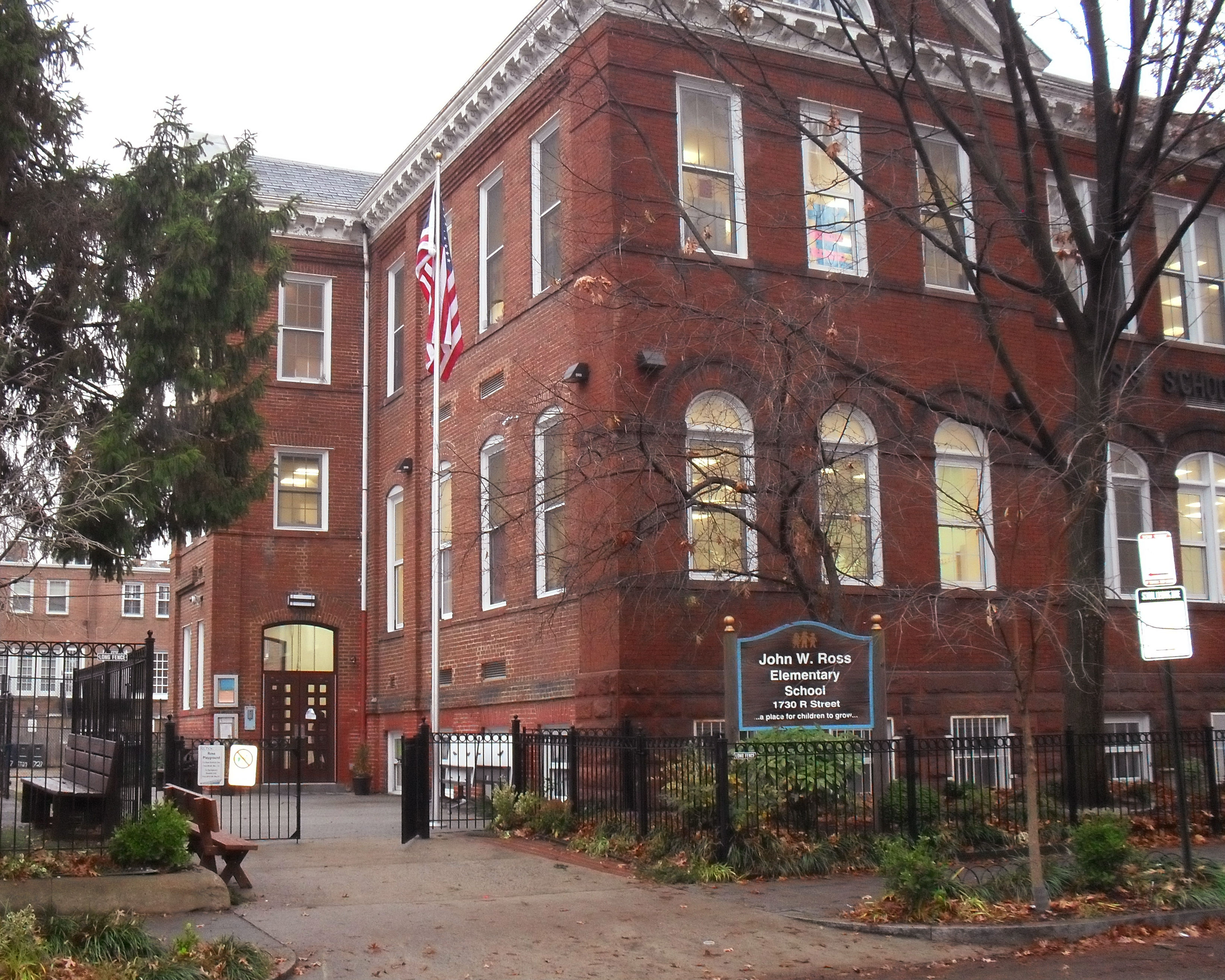
Ross Elementary School at Dupont Circle will be one of the only elementary schools from Georgetown to Chinatown, if Francis-Stevens Education Campus and Garrison Elementary School are closed. Photo: Annette Birch.
by Annette Birch
The school system wants to close two schools, noting that there are fewer school-aged kids in the area. But parents are upset, arguing that the schools their kids will be sent to are too full already and more kids may be coming soon.
John W. Ross Elementary School at Dupont Circle, which only has the capacity to hold 250 students and one class per grade, will be one of four elementary schools from Georgetown to Chinatown, if Francis-Stevens Education Campus and Garrison Elementary School are closed.
Melissa Salmonowitz, spokesperson for District of Columbia Public Schools, a government agency under the District of Columbia, did not think that the closings will be a problem for kids in the Dupont Circle area.
“We don’t anticipate any consequences for Ross students, should Francis-Stevens or Garrison be consolidated in the 2013-2014 school year.” On the contrary, closing the schools would, in her opinion, allow money to be spent offering more services to the remaining schools.
Timothy R. Ryan, who lives at Foggy Bottom, just next to the Dupont Circle area, does not agree. He enrolled his 3-year-old son in the pre-school at Francis-Stevens Elementary School instead of a private daycare, because he wanted him close to the community and with kids from different backgrounds.
“It would be horrendous. This is the community school for the Foggy Bottom and Dupont Circle area. Ross is already full and there is no other walkable school option. It would have a very big impact on the community,” Ryan said.
Kids would be put in trailers
Kaya Henderson, chancellor of District of Columbia Public Schools, proposed on Nov. 13 that 20 public schools, among these Francis-Stevens and Garrison, should be closed, due to fewer families with kids in school age. Both Francis-Stevens and Garrison are under enrolled and over half of the kids are from outside the school district.
However, Lord pointed out that Ross and the two other elementary schools, besides Seaton, where the kids from Francis-Stevens would be send, is already overbooked.
“There are already very few schools in ward two. Ross Elementary School is already oversubscribed, parents within the ward’s boundary cannot get in there.” She also pointed to that according to the chancellor’s own plan population projections indicate that the school-age population from 2015 may grow in the center of the city.
Ann McCloud, president of the Parent Teacher Association (PTA) at Garrison Elementary School, was also afraid that Seaton Elementary School, where kids within the school district should go to, would not have the capacity to provide a proper education for all kids.
“Because of the capacity of the school, the kids would be put into trailers to provide for temporary classrooms in the school yard,” she predicted.
Ryan knows what he would do if Francis-Stevens is closed.
“I will move if Francis-Stevens closes, even though I have lived here for 20 years. I will not feel comfortable sending my son to a school on the other side of Adams Morgan, where the crime rates are higher,” he said.
Prospects for the future are still uncertain
Bob Meehan, member of the Advisory Neighborhood Board (ANC), a group of elected neighborhood representatives, at Dupont Circle, thinks that the protests will have an impact on the decision to close the schools.
“I don’t think they will close, because there is so much support for these schools from the parents and city council member Jack Evans,” he said.
Lord was not as sure. However, she admitted that there was need for reform, especially with clear cases of under enrollment, but pointed to that the central office at least should have talked with the principals and teachers before they made the proposal and do an assessment of the problems and opportunities of each school.
“I would recommend that we have a community assessment, which goes with every school. It has to be about improving performance for kids and taking into consideration the special needs of the community and each school’s personality,” Lord said.
Meanwhile, the parents in or near the Dupont Circle area will have to wait for the chancellor’s decision, which is expected in January 2013.
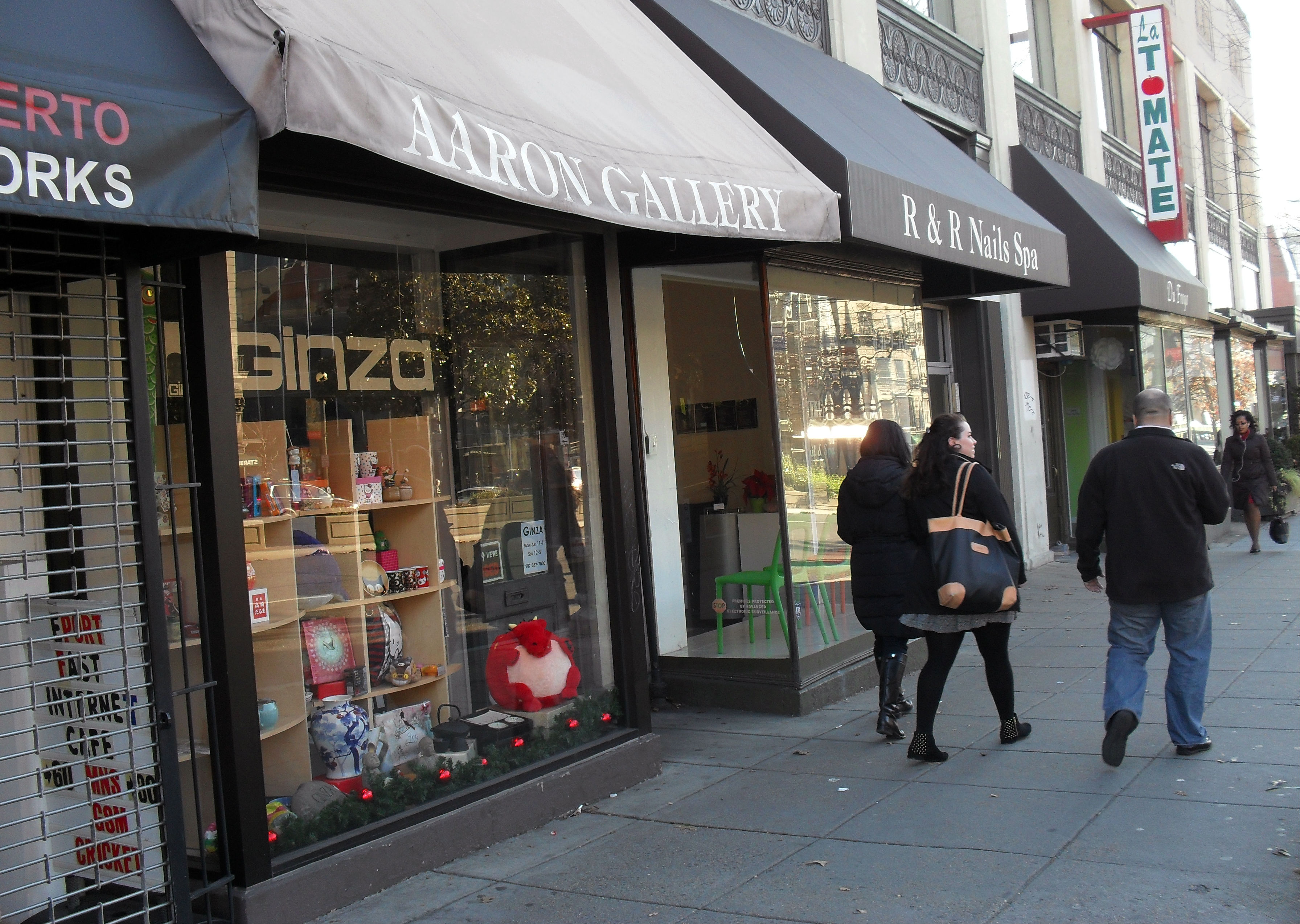
Ginza , a local Japanese shop, is back again at Connecticut Avenue. Photo: Annette Birch
by Annette Birch
Like an increasing number of local businesses in Dupont Circle, Ginza recently moved. The small Japanese shop has been in the area since 1980, but due to higher rents and fewer customers it had to move to a smaller space two doors down from its original site. Its windows exhibited everything from tea cans and porcelain to stuffed animals and DVDs, all imported from Japan.
Ginza’s owner, Virginia Yoneyama, explained that she had been looking for a smaller and cheaper space for some time in order to cover expenses. For even though the regular customers who live near Dupont Circle still shopped at Ginza, the total number of customers has gone down and expenses have gone up.
“We were closing because of the economy. The rent keeps on going up in the city and now people are more careful with their money.” Yoneyama pushed her long white hair with gray, brown and black strands back from her face and walked over to help a woman in her fifties who was wearing big earrings dangling around her face.
Business at Dupont Circle is changing
Rent in Washington, D.C. has been increasing gradually over the last 10 years. Reis, Inc., a private research firm providing real estate data, estimated that in 2011 rent alone increased with 5.4 percent and rent hikes went up to 10 percent.
Ginza is not the first local business at Dupont Circle which had problems with rent going up and number of customers going down. Farther down the street, a sign shows that Melody Record Store, which had been there since 1977, went out of business in January. The shop is still empty. On the other side of Connecticut Avenue, Benetton replaced a movie theater 12 years ago and the same year Starbucks replaced an old fashioned drug store. However, Kramerbooks, a local book store which has been at Dupont Circle for 37 years, is still there.
Yoneyama remembered when Ginza in 1980 moved to Dupont Circle from 20th and K Street where it had been since 1955. “There was very little here, when we first moved here, more small stores.” Yonemaya, who took over the shop in 1988, explained that the shop moved to Dupont Circle, because the area provided for a large market and was very progressive and accepting.
On the other side of the street a small used book store, Kultura, has been at Dupont Circle since 1980. Standing outside smoking a cigarette, the owner and local resident Irene Caoray said the neighborhood had changed a lot.
“Before it was more urban living as opposed to restaurants and more local customers. Now it is mostly customers from outside. The area gets trashy. Lots of restaurants and bars, the quality of business decline,” she said over the noise of a police siren coming down the street, while adjusting a strand of gray hair.
However, at Dolcezza, a small coffee chain shop farther down the street, Brett Dakin, a lawyer visiting from New York with a nostalgic feeling from his high schools days for Dupont Circle, did not agree.
“Generally, I like the way things are going. It is becoming a more interesting neighborhood with more places to eat and more individual shops,” Dakin said while enjoying a cup of coffee at the large common table.
Giving back to the community
Some Dupont Circle residents worry that more chain stores could mean less business participation in the community. Bob Meehan, who for 10 years has been a Commissioner for Advisory Neighborhood at Dupont Circle, a group of elected neighborhood representatives, found that the change in the business structure could have consequences for local business participation in Dupont Circle community initiatives such as Main Streets, a government initiative to improve business opportunities.
“Local stores participate more in local initiatives like Main Streets. National firms’ branches use other criteria. For example, Starbucks national has no interest in Dupont Circle. It depends on the brand and is less cooperative in issues on trash, local community and like,” Bob Meehan said.
Representatives from Starbucks, a national coffee chain, and Ann Taylor, a national retailer clothing store which has a local shop south of Dupont Circle, had no comment. But employees of some national chains disputed that idea. Rachel Mezynski, store manager for Benetton, a national retailer shop for women’s clothes which has been at Dupont Circle since 2000, explained that most of the local shop’s customers were from the neighborhood or tourists.
Just next door to Benetton, G-Star Raw, another national retailer clothing store which has been at Dupont Circle since 2008, Gregory Lennon, who is the District Manager for G-Star Raw at Dupont Circle, added that even though G-Star Raw is part of a larger corporation, the local store takes an interest in the local community.
Lennon pointed to a recent fundraiser for the Sexual Minority Youth Assistance League, which supports lesbian, gay and bisexual youth in the Washington, D.C. area.
“We partner with local charities to give back to the community,” he said.
Baby boom creates new opportunities
Though rents have increased, not all of the news is bad. Yoneyama says she’s getting more business now from young families. Population estimates from the U.S. Census, show that in 2010 there was an increase of 5.4 percent in children under 5 years old in Washington, D.C., most of it due to more children up to three years old.
In the shop, a 3-year-old girl with light-brown hair wearing a pink striped coat looked around at the big stuffed animals, the small toy bears in pink, orange and purple, and pictures of kittens on cups and bags. Her parents, a young couple in jeans and coats, kept an eye on her.
“Customers are changing. They are getting younger and we have to change our product base towards the younger people in their 20s and 30s,” Yoneyama said and went over to assist her new customers.
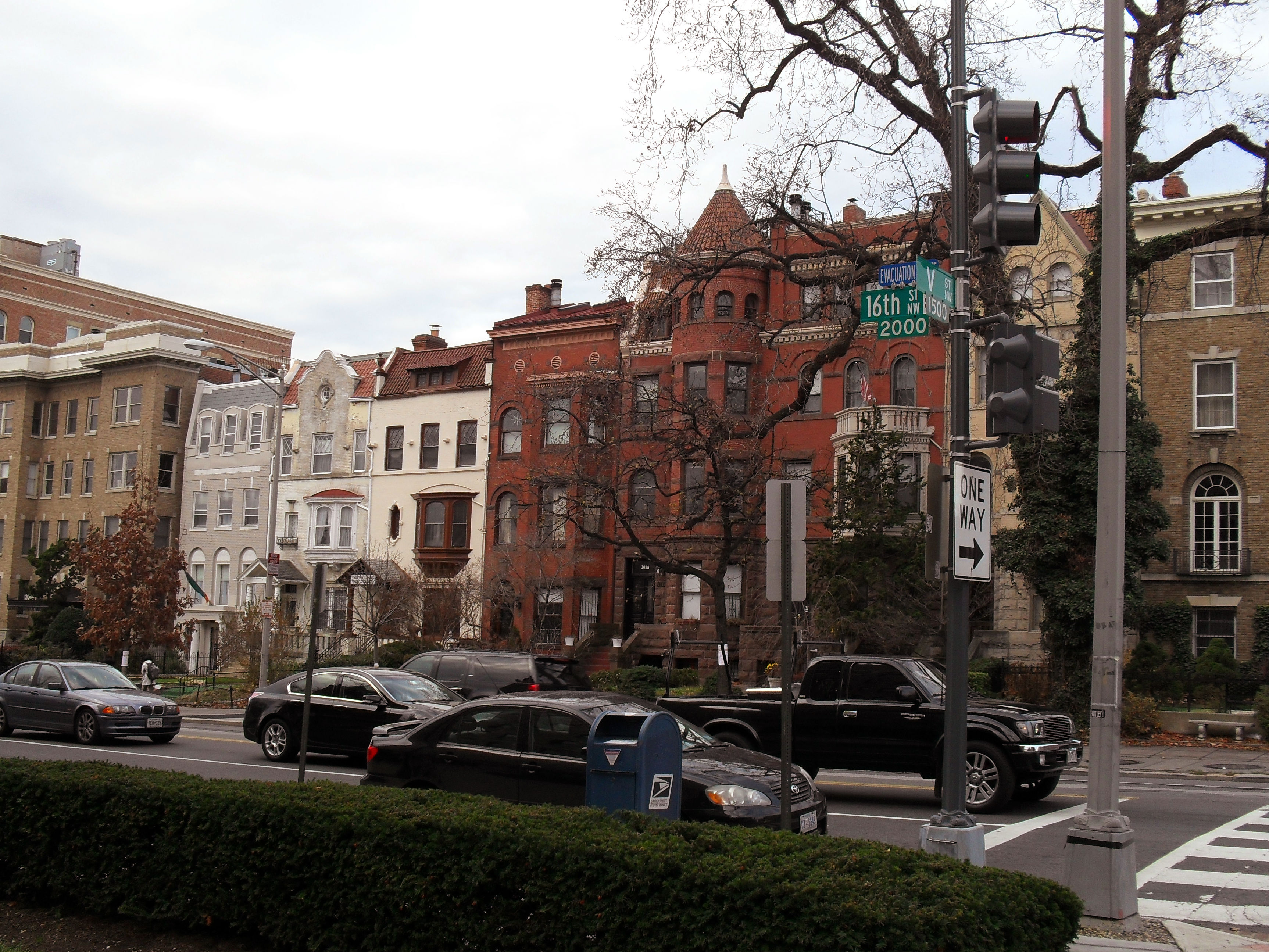
A 27-year-old man was arrested near the Dupont Circle area for conspiracy to distribute drugs. Photo: Annette Birch
by Annette Birch
Police has indicted 34 persons on charges of selling heroin, cocaine and other drug throughout the greater D.C. area. One of them, Ricky Canty, 27, was arrested near Dupont Circle on Nov. 30. He is accused of participating in an illegal drug operation in the Georgia Avenue corridor, 17th and Euclid Streets NW, the 1600 block of Fuller Street NW and several other areas in Washington, D.C., Maryland and Virginia.
Ricky Canty is presently being detained and has pleaded not guilty to the charges. William Miller, spokesman from the U.S. Attorney’s Office, declined to give further information on the case because of the pending prosecution.
Drugs are a problem, but on a smaller scale
Ricky Canty was picked up by the police at 1600 block of V-Street, a residential area surrounded by the local police station and embassies. However, arrest records from the third district of the Metropolitan Police of the District of Columbia, which spans from Georgetown to Chinatown, showed that drug arrests in other places of the third police district are not uncommon. In the last month, arrests for drug-related crimes constituted 22 percent of arrests for that district.
Most of the arrests are possession or distribution of smaller amounts of drugs, mostly marijuana, but also smaller amounts of cocaine and heroin.
Marco Santiago, who is spokesman for the third district in the Metropolitan Police District of Columbia, confirmed that this is a general trend in the third district.
“A lot of it is a little bit of crack, marijuana and 1 percent of meth,” Santiago said. Exact figures were unavailable because the police department is currently reviewing its records on drug-related offenses.
Drug crimes move westwards
However, even small drug-related crimes are much more likely to take place farther east at 11th and 12th Street. Crime statistics from the police showed that crimes near the Dupont Circle area are much more likely to be theft and larceny.
Kishan Putta, newly elected member for the Advisory Neighborhood Board 2B, a government group made up of elected neighborhood representatives, agreed that the Dupont Circle area is fundamentally a very safe place. However, he also indicated that the new construction area at 14th and U-Street, an area close to Dupont Circle, were more likely to bring crime closer to Dupont Circle.
“There are many new people coming in and as there are many longtime residents there is a potential for conflicts. The new residents are buying old buildings and making them better, but at the same time there are also low-income citizens and they should co-exist together,” he said.
Santiago said that revitalization efforts would ultimately help reduce crime in the area, but in the short term they might lead to more problems.
“The baggage of the revitalization of 14th and U-Street is prostitution and drugs, because a lot of construction workers frequent these,” he said.

The District of Columbia can become the first jurisdiction to recommend the federal implementation of the DREAM Act to Congress. Photo: Todd Dwyer, Flickr, http://bit.ly/XG1KA
by Annette Birch
Washington, D.C., is considering a resolution recommending Congress pass an act granting a path to citizenship for illegal immigrants who came to the United States as children under certain circumstances.
If approved by the city council, the resolution would be the first passed in favor of the DREAM Act by a local or state government.
Lizette Arias, who testified at the city council public hearing on Nov. 13, came to the United States from Bolivia when she was two months old and does still not have a residence permit.
“I lived a very different life than if I had been documented. As a child, there was always the danger of being deported and my parents did not want me to travel, and there was always the danger of being deported,” she said.
Arias graduated from college last year and is now interning part-time at DREAM project, Inc., a non-profit organization paying for immigrants to go to college.
“I like to think that I make a difference for people like me.” In September, she applied for deferred action, which, if granted, would give her a two-year work permit, but would not give her lawful status.
A good education is often not an option for illegal immigrants
Immigration Policy Center, a non-profit organization which provides research and analysis about immigrants and immigration in the United States, estimates that there are 1,711 foreign born persons under 30 years old in the District of Columbia, like Arias, would meet the general requirements for the DREAM Act. Of these 94 percent are of Latino origin, 2 percent of Asian origin, 2.7 percent of European origin and 1.3 percent comes from other regions.
Latin American Youth Center, a non-profit organization which helps Latino and African immigrant youths 11 to 24 years old, believes that the biggest problem for illegal immigrants is that they cannot access the resources available.
“They cannot go to college, get well paid jobs, take English classes or access community resources, if they do not have documentation,” said Ariseli Rosenburger, a spokeswoman for the Development Communication Manager at the Latin American Youth Centre.
Arias had to fight to get into a good college, while her sister who is two years younger and born in the United States got into her dream college without problems, got driver license and could travel abroad. “It was especially hard, when I was in high school and wanted to go to college as I did not qualify for in-state tuition, even though I got straight A’s, and the outer state and national colleges were too expensive,” she said.
DC Council resolution can get the ball rolling
Crispus Gordon, legislative assistant to the D.C Council Judiciary Committee, emphasized that this action is not the same one taken by Maryland, which passed its own version of the DREAM Act. “This is an official statement from D.C. Council asking Congress to pass the federal DREAM Act.” In order to get adopted the resolution needs to be adopted by a majority vote at the DC Council Judiciary Committee in Nov. 29 and by the Committee of the Whole at a meeting to be held between Dec. 4 and Dec. 18.
However, both Arias and Rosenburger believes that it would be a strong signal to Congress, if the resolution got adopted. “The D.C. Council resolution could get the ball rolling. Hearing people’s voices might influence things on a national level,” Rosenburger said.

Margret Kroyer with one of her pictures. Photo: Annette Birch
by Annette Birch
Margrét Kröyer has two goals: to make art and to help children learn about art. The Iceland native moved to Washington in 2009 to make a living from her art and help children and teen-agers who cannot afford art school. “I think everyone should have access to art,” said Kröyer, 45.
Kröyer’s apartment is full of her brightly colored paintings, hanging on or leaning against the wall. Some of her other paintings are exhibited at galleries in Washington, D.C.
ArtJamz, a Dupont Circle shop where anyone can paint, is promoting Kröyer at a bazaar on Nov. 18. The bazaar is being held in collaboration with ArtSee, an organization that promotes art.
Need for promoting local art
Michael M. Clemens, chief creative enabler at ArtJamz, was inspired to hold the bazaar by the local artists who work at ArtJamz and other artists who come there to paint. “One of the challenges for the local artists is to have someone to showcase their work. The goal is to get the art out to the general public, also those who do not go to art exhibitions and make ArtJamz a gateway where people can get involved in art,” she said.
ArtJamz has 12 local artists. Among them is Lindsay Routt who is also exhibiting her paintings at the bazaar. The 23-year-old juggles a full time job as an event and meeting coordinator, volunteers at ArtJamz and works as an artist. She expects to be able to meet local people and get new ideas from the Bazaar. “It is nice to sell work, but I also like to see and interact with the people, hear their stories, get ideas,” she said.
Engaging in the local community
Kröyer believes that Dupont Circle presents a wide range of opportunities for new artists. “Dupont Circle is such a great place for an artist, accessible and full of small galleries and museums. It is easy to form connections if you are just open,” she said.
ArtJamz wants to take part in that tradition. “It is just natural if you have a local studio you want to support local artists,” Clemens explains. “You cannot just focus on your own business. It is like the saying ‘A rising tide lifts all boats.’ When you think about local artists, you do not just think about your own business, but help the art scene to rise.”
Jack Jackson, secretary of the Urban Neighborhood Alliance thinks that ArtJamz can help promote artists in Dupont Circle, a goal of his group. Urban Neighborhood Alliance is a local organization that sponsors the 17th Street Festival, where local business gets the opportunity to meet local artists. Mike Feldstein, Vice Chair of Dupont Circle Advisory Neighborhood Commission 2B, a government agency made up of elected neighborhood representatives, agrees. “It is a great idea and we would like to encourage this kind of initiative, because it could help the community,” he said.
Clemens doesn’t know if there will be another event in the future. “I do want to follow up on the bazaar, but whether it will actually happen, will depend on the success of the bazaar.”
 Annette Birch